EBT cash vs SNAP food benefits: what each balance can buy
One EBT card can hold SNAP food benefits and a separate cash balance. What each pays for, cash back and ATM rules, fees, and where federal law blocks cash use.
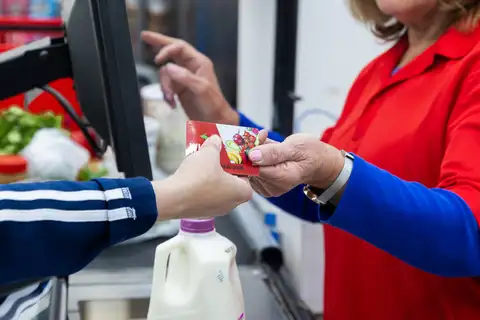
Your EBT card can hold two separate balances. The SNAP (food) balance pays only for eligible food at SNAP-authorized stores, and it can never be turned into cash. The cash balance holds money from a cash program such as TANF. You can spend it on almost anything, take it out at an ATM or get cash back at a store. Federal law sets one limit on the cash side: states must block cash benefits from being used at liquor stores, casinos and gaming places, and strip clubs (42 U.S.C. 608(a)(12)). Many states add their own list on top of that. At the register you choose which balance to use, and you can split one shopping trip between them.
Two programs, one card
USDA sets SNAP’s rules and states run it. EBT has been the only way SNAP is issued in every state since June 2004 (USDA, Electronic Benefits Transfer, page updated February 9, 2026). Federal SNAP rules describe EBT as a system for delivering “food and other public assistance benefits.” So states load their cash programs onto the same card (7 CFR 271.2).
What goes in the cash balance depends on your state and your case. Common examples:
- TANF, the federal-state cash program for families with children. It goes by a state name in many places, such as CalWORKs in California or Temporary Assistance in New York.
- Other state cash programs. Massachusetts pays both TAFDC and EAEDC cash assistance through the same card (Massachusetts DTA, Using Your EBT Card).
- Other cash programs a state chooses to deliver by EBT. California’s card carries “CalFresh, CalWORKs, and other program” benefits (California Department of Social Services, EBT).
You have a cash balance only if you were approved for one of these programs. Most SNAP households have a food balance only.
| SNAP food balance | Cash balance (TANF and similar) | |
|---|---|---|
| Who sets the rules | USDA, plus a few state waivers on items such as soda and candy | The state, within federal TANF law |
| What it buys | Eligible food for home use, and seeds and plants that grow food | Food and non-food items, rent, bills |
| Cash back or ATM | Never | Yes, where the store or ATM offers it |
| Sales tax | Not charged on food bought with SNAP | Charged like any other payment |
| Fees | No transaction fees allowed | Depends on the state: some ATM withdrawals cost a fee |
| Blocked places | Stores not authorized for SNAP | Liquor stores, casinos, strip clubs under federal law, plus each state’s own list |
| Out of state | Works at SNAP stores in any state | Usually works where EBT cash is accepted; states advise checking fees |
What the SNAP balance can and cannot pay for
SNAP buys food for the household to prepare and eat at home. It also buys seeds and plants that grow food. It does not buy alcohol, tobacco, vitamins and supplements, hot foods, pet food, or household goods such as soap and paper products (USDA, What Can SNAP Buy?, page updated June 4, 2025). The full list, including energy drinks and other edge cases, is in our guide to what you can buy with EBT.
Four rules make the SNAP balance work differently from cash:
- No cash, ever. A store may accept SNAP “only in exchange for eligible food” and may not exchange it for cash (7 CFR 278.2(a)). Massachusetts says it plainly: “You cannot redeem SNAP benefits for cash” (Massachusetts DTA).
- No sales tax. Stores must charge SNAP shoppers the same prices as other customers, “except that tax shall not be charged on eligible foods purchased with” SNAP (7 CFR 278.2(b)).
- No fees, no minimum. States may not set a minimum purchase or a limit on the number of transactions. They may not charge SNAP households transaction fees (7 CFR 274.7(c)). Online, SNAP cannot pay delivery, service or convenience fees (USDA, SNAP Online Purchasing, page updated February 17, 2026). You pay those another way.
- Container deposits. SNAP can pay a bottle or can deposit only up to the amount set in state law. Anything above that must be paid “in cash or other form of payment other than with SNAP benefits” (7 CFR 274.7(j)).
State food restriction waivers apply to the SNAP balance. Starting in 2026, several states have barred buying soda, candy or similar items with SNAP under USDA waivers (see SNAP food restriction waivers). These are SNAP rules. Texas shows the split: its Lone Star Card FAQ lists candy and sweetened drinks among the things “you can’t use SNAP to buy.” Its list of what TANF cannot buy names alcohol, tobacco, lottery tickets and similar items, not candy or soda (Texas HHSC, Lone Star Card FAQ). Check your own state’s page before you rely on this.
What the cash balance can pay for
Cash benefits are meant to be spent like money. New York’s EBT page says: “Any item may be purchased using your cash benefit account where EBT cards are accepted” (New York OTDA, EBT). Texas lists “food and other items such as clothes, housing, furniture, transportation, laundry, medical supplies and supplies for the home” (Texas HHSC). Massachusetts names rent, utility bills, money orders and food (Massachusetts DTA).
Many people take the cash out, because a landlord or utility will not take an EBT card. You can do that at an ATM, as cash back with a store purchase, or, at some stores, as a cash withdrawal without buying anything. Some states also let you have cash benefits paid by direct deposit to your own bank account instead of the card. Massachusetts offers this, and then your EBT card is used for SNAP only (Massachusetts DTA).
Where federal law blocks cash benefits
Since a 2012 law, every state must have policies to stop TANF cash from being used in any EBT transaction in three kinds of places (42 U.S.C. 608(a)(12)):
- Liquor stores. The law means a store that sells “exclusively or primarily” intoxicating liquor. A grocery store that also sells beer or wine does not count.
- Casinos, gambling casinos and gaming establishments. A grocery store inside or next to a casino does not count, nor does a business where gambling is only incidental.
- Adult entertainment where performers disrobe or perform unclothed.
“EBT transaction” here covers ATM withdrawals as well as purchases. A state that did not report or put these policies in place within two years of February 22, 2012 faces a penalty of 5% of its TANF block grant (42 U.S.C. 609(a)(16)). The same law requires each state to keep ATMs and card terminals in those places from giving out TANF cash (42 U.S.C. 602(a)(1)(A)(vii)).
States that go further
States can and do block more. Three examples, as published by each agency:
| State | Places or purchases where cash benefits cannot be used (agency’s own list) |
|---|---|
| California | ATMs and card terminals in liquor stores that do not accept CalFresh; casinos, poker rooms, card rooms, adult entertainment businesses, bail bonds, night clubs, saloons and taverns, bingo halls, race tracks, gun and ammunition stores, cruise ships, psychic readers, smoking shops, cannabis shops, tattoo and piercing shops, and spa and massage salons (CDSS notice TEMP 2245, a 2011 notice; ask your county office whether the list has changed) |
| Massachusetts | Cannot buy alcohol, court fees, fines, bail or bail bonds, firearms and ammunition, gambling, lottery tickets, jewelry, adult entertainment material, marijuana or tobacco. Card cannot be used at adult book stores, firearm dealers, casinos, cruise ships, jewelry stores, liquor or marijuana stores, tattoo parlors, nail salons, cash transmittal agencies or smoke shops (Massachusetts DTA) |
| New York | Liquor stores, wine stores, beer and beverage centers, racetracks, casinos, video lottery facilities, off-track betting, commercial bingo, and adult entertainment with nudity, whether in New York, another state or on Tribal lands (New York OTDA) |
Texas lists purchases rather than places. Its TANF cash cannot buy “alcoholic drinks, tobacco items, lottery tickets, adult entertainment, guns, ammunition, bingo or illegal drugs” (Texas HHSC). If your card is declined for a cash withdrawal at a bar, smoke shop or casino ATM, this is usually the reason. Your benefits are not missing. Your state page lists the agency that sets your rules.
Paying at the register: splitting one purchase
At the card reader you pick the balance: “EBT Food” or “SNAP” for the food balance, “EBT Cash” or “TANF” for cash. Massachusetts describes it like this: your eligible SNAP items are charged to SNAP when you insert, tap or swipe and enter your PIN. For toiletries and other items, you “use your cash benefits by inserting or tapping the card again, selecting ‘EBT Cash’, and entering the PIN” (Massachusetts DTA). If the machine confuses you, Texas tells cardholders to give the cashier the card and say which account to charge, but never to give the cashier the PIN (Texas HHSC).
Worked example. Your basket at a supermarket has $64.30 of groceries and $11.50 of paper towels and shampoo. In this example, sales tax on non-food items is 8%; use your own local rate.
- Groceries on the SNAP balance: $64.30, no sales tax (7 CFR 278.2(b)).
- Paper towels and shampoo on the cash balance: $11.50 + ($11.50 × 0.08 = $0.92 tax) = $12.42.
- Total taken from the card: $64.30 + $12.42 = $76.72, in two transactions.
With no cash balance, you would pay the $12.42 another way. The SNAP balance will not cover it, and the register should not let it.
Read the receipt. Federal rules require it to show the transaction type, the amount and the SNAP balance left (7 CFR 274.8(b)(7)). If a charge went to the wrong balance, report it promptly. For SNAP, the state must act on your request for an adjustment made within 90 days of the error, and has 10 business days from your report to decide and move the money back (7 CFR 274.2(g)). Texas also gives 90 days to report an error on a Lone Star Card account, at 1-800-777-7328 (Texas HHSC).
Getting cash out: ATMs, cash back and fees
SNAP must be fee-free. Cash withdrawals are different. Federal TANF law requires each state to give recipients access to their cash “with minimal fees or charges, including an opportunity to access assistance with no fee or charges,” and to make fee and surcharge information public (42 U.S.C. 602(a)(1)(A)(viii)). Within that rule, each state sets its own fees. Two fee charges can stack: the state’s EBT fee and the ATM owner’s surcharge.
| State | Store purchase or cash back | ATM withdrawals |
|---|---|---|
| Texas | No fee for TANF purchases or for cash back with a TANF purchase | No fee for taking out $49 or less. For $50 or more: two free per month, then 50 cents each (Texas HHSC) |
| Massachusetts | No fee for cash withdrawal or cash back at stores with the Quest sign | 75 cents for the 4th and each later ATM withdrawal in a month, from any ATM, plus any bank surcharge. Balance checks at ATMs are free (Massachusetts DTA) |
Worked example, Texas. You have $300 of TANF cash on your Lone Star Card.
- One $300 ATM withdrawal: the first of your two free $50-plus withdrawals that month. State fee: $0.
- Four $75 withdrawals in the same month: two free, then 2 × $0.50 = $1.00 in state fees.
- Cash back at a store with a TANF purchase: $0 state fee.
The ATM owner may add its own surcharge to any ATM withdrawal. Check the fee notice on the machine before you confirm.
Worked example, Massachusetts. Five ATM withdrawals in one month cost 2 × $0.75 = $1.50, for the 4th and 5th, plus any bank surcharge. Taking the same cash back at a store with the Quest sign costs nothing. The agency suggests keeping to three ATM withdrawals a month.
Stores set their own limits on cash back and on cash withdrawals without a purchase. Texas says “some stores only let you take out a certain amount at one time” (Texas HHSC).
Using either balance in another state
SNAP is portable by federal rule. Your card must work at SNAP-authorized stores in any state (7 CFR 274.8(b)(10)). For cash, states make no such promise. New York says its recipients can reach cash and SNAP “anywhere within New York State and nationwide” at participating locations (New York OTDA). Texas says TANF “should” work at stores that take cash benefits in other states. It advises: “To be safe, withdraw your money from your cash account before you leave Texas,” and to ask a store about its fee first (Texas HHSC). If you move out of state, report it: Texas asks for that change within 10 days.
If you blocked out-of-state transactions in your state’s card app, unblock them before you travel. California’s ebtEDGE settings let you block out-of-state and internet transactions (CDSS).
Unused benefits and stolen benefits
Unused SNAP stays on the card from month to month. It is spent oldest first. A state removes (“expunges”) it after 9 months, either 274 days with no card activity or nine months after it was issued, depending on the state’s choice (7 CFR 274.2(i)). Unused cash follows your state’s TANF rules. Texas, for example, says benefits you do not use “stay in your account for nine months from the date they are put into your account” (Texas HHSC).
Stolen benefits. Report a lost or stolen card at once. In Texas, your PIN and balance move to the replacement card, but benefits taken before you call are gone: “If someone steals your benefits before you call us at 800-777-7328, you lose those benefits.” Bank-card protections do not help here. The federal Electronic Fund Transfer Act and its fraud-liability limits “shall not apply” to a state-run EBT system for needs-tested benefits. The exception is benefits paid by direct deposit into your own bank account (15 U.S.C. 1693b(d)(2)). Federal replacement of skimmed SNAP ended December 20, 2024. Our guide to EBT skimming and stolen benefits has the details, and lost or stolen EBT card covers replacements.
Never trade SNAP for cash
Selling SNAP benefits, or the card and PIN, “for cash or consideration other than eligible food” is trafficking under federal rules. So is buying food with SNAP to resell it for cash, and buying drinks in deposit containers just to dump them and cash in the containers (7 CFR 271.2). An intentional program violation bars that person from SNAP for 12 months the first time, 24 months the second time and permanently the third time. A court conviction for trafficking $500 or more means a permanent ban on the first offense (7 CFR 273.16(b)). Withdrawing your own TANF cash at an ATM is legal. Turning your food balance into cash is not.
Checking both balances
Your state’s EBT customer service line and cardholder website show your balances. New York’s 24-hour helpline at 1-888-328-6399 gives “SNAP or cash account balance information” (New York OTDA). Each state’s number and cardholder site:
For every way to check, see how to check your EBT balance.
Sources
- 42 U.S.C. 608, Prohibitions; requirements (paragraph (a)(12), EBT transaction restrictions), U.S. Code, 2023 edition, GPO (checked 2026-10-16)
- 42 U.S.C. 602, Eligible States; State plan (paragraphs (a)(1)(A)(vii)-(viii)), U.S. Code, 2023 edition, GPO (checked 2026-10-16)
- 42 U.S.C. 609, Penalties (paragraph (a)(16)), U.S. Code, 2023 edition, GPO (checked 2026-10-16)
- 15 U.S.C. 1693b, Regulations (paragraph (d)(2), state EBT systems), U.S. Code, 2023 edition, GPO (checked 2026-10-16)
- 7 CFR 271.2, Definitions, eCFR, up to date as of October 14, 2026 (checked 2026-10-16)
- 7 CFR 273.16, Disqualification for intentional Program violation, eCFR (checked 2026-10-16)
- 7 CFR 274.2, Providing benefits to participants, eCFR (checked 2026-10-16)
- 7 CFR 274.7, Benefit redemption by eligible households, eCFR (checked 2026-10-16)
- 7 CFR 274.8, Functional and technical EBT system requirements, eCFR (checked 2026-10-16)
- 7 CFR 278.2, Participation of retail food stores, eCFR (checked 2026-10-16)
- Electronic Benefits Transfer (EBT), USDA (page updated February 9, 2026; read via the agency’s CDN copy)
- What Can SNAP Buy?, USDA (page updated June 4, 2025; read via the agency’s CDN copy)
- SNAP Online Purchasing, USDA (page updated February 17, 2026; read via the agency’s CDN copy)
- Lone Star Card FAQs and Lone Star Card, Texas Health and Human Services Commission (read through a text reader; checked 2026-10-16)
- Using Your EBT Card, Massachusetts Department of Transitional Assistance (read through a text reader; checked 2026-10-16)
- Electronic Benefits Transfer (EBT) Card, New York State Office of Temporary and Disability Assistance (read through a text reader; checked 2026-10-16)
- Electronic Benefits Transfer (EBT), California Department of Social Services (checked 2026-10-16)
- Important Information About Electronic Benefit Transfer (EBT), notice TEMP 2245, California Department of Social Services, form dated 1/11 (checked 2026-10-16)