SNAP for seniors and people with disabilities: the special rules for 2026-2027
FY2027 SNAP rules for people 60+ or disabled: no gross income test, a $4,750 asset limit, medical and uncapped shelter deductions, and longer renewals.
If anyone in your household is 60 or older, or gets a disability benefit such as SSI or Social Security disability, SNAP uses easier rules for your household. From October 1, 2026 to September 30, 2027 (federal fiscal year 2027), these households skip the gross income test and only have to pass the net income test ($1,330 a month for one person in the 48 states and D.C.). They can have up to $4,750 in countable assets instead of $3,000. Medical costs over $35 a month are subtracted from their income. Their housing costs are subtracted with no cap. Where every adult is elderly or disabled, the state can approve them for up to 24 months (7 CFR 273.10(f)(1)), and some state projects allow 36. The other rules in this paragraph are on USDA’s Special Rules for the Elderly or Disabled page (updated October 1, 2026). The 2025 federal law changed two things for this group. Since July 4, 2025, people aged 60 to 64 face the SNAP time limit, and a LIHEAP payment raises the utility allowance only for households with an elderly or disabled member. Both are explained below.
Who counts as “elderly” or “disabled” in SNAP
Elderly means 60 or older. The One Big Beautiful Bill Act of 2025 did not change that age. USDA told states on June 11, 2026 that people 60 and older keep the medical deduction and the uncapped shelter deduction (USDA Time Limit Q&A #1, question 1).
Disabled has a narrow meaning in SNAP. It depends mostly on getting certain benefits, not on a diagnosis. A household member counts as disabled if they (7 CFR 271.2, “Elderly or disabled member”):
- get Supplemental Security Income (SSI), or Social Security disability or blindness payments;
- get state supplemental payments or state disability benefits that use SSI’s disability rules;
- get a government disability retirement benefit for a disability Social Security would consider permanent;
- are a veteran with a VA disability rating of total (or paid as total), or whom the VA finds needs regular aid and attendance or is permanently housebound;
- are a veteran’s surviving spouse or child who meets certain VA disability tests;
- get a Railroad Retirement disability annuity and qualify for Medicare or meet SSI’s disability rules; or
- get interim assistance while an SSI claim is pending, disability-based Medicaid, or disability-based state general assistance, if the state’s test is at least as strict as SSI’s.
One elderly or disabled person is enough for most of the special rules: the net-only income test, the $4,750 asset limit and the uncapped shelter deduction. The medical deduction covers only the costs of the elderly or disabled members themselves. Some rules need everyone to qualify, such as 24-month certification (all adults) and the Restaurant Meals Program (all members).
What changes for these households, at a glance
| Rule | Most households | Households with a member 60+ or disabled, FY2027 |
|---|---|---|
| Gross income test (130% of poverty, or the state’s higher limit) | Must pass | Does not apply |
| Net income test (100% of poverty) | Must pass | Must pass |
| Federal asset limit | $3,000 | $4,750 |
| Medical expenses | Not deductible | Costs over $35 a month deducted |
| Excess shelter deduction | Capped at $769 (48 states and D.C.) | No cap |
| Heating/cooling allowance through LIHEAP | No longer automatic since July 4, 2025 | Still automatic |
| Certification period | Up to 12 months | Up to 24 months if all adults qualify |
| General work requirements | Ages 16-59 unless exempt | None for people 60+ or unfit for work |
Sources: USDA FY2027 cost-of-living memo, August 21, 2026; 7 CFR 273.9; 7 CFR 273.10(f); 7 CFR 273.7(b); USDA energy assistance Q&A, May 8, 2026.
Income: only the net test applies
Most households must pass two income tests. The gross test is 130% of the poverty line, or a higher limit in states that use broad-based categorical eligibility (BBCE). The net test is 100% of poverty, applied after deductions. A household with an elderly or disabled member “only has to meet the net income test” (USDA). This matters most for seniors with a pension or a larger Social Security check. A couple can be well over the gross limit and still qualify once medical and housing costs are subtracted (see example 2 below).
The FY2027 federal standards, including the 165% column used for the separate-household rule:
| Household size | Gross (130%) | Net (100%) | Elderly/disabled separate household (165%) |
|---|---|---|---|
| 1 | $1,729 | $1,330 | $2,195 |
| 2 | $2,345 | $1,804 | $2,976 |
| 3 | $2,960 | $2,277 | $3,757 |
| 4 | $3,575 | $2,750 | $4,538 |
| 5 | $4,191 | $3,224 | $5,319 |
| 6 | $4,806 | $3,697 | $6,100 |
| 7 | $5,421 | $4,170 | $6,881 |
| 8 | $6,037 | $4,644 | $7,662 |
| Each additional person | +$616 | +$474 | +$781 |
Your state’s own gross limit is in SNAP income limits by state. If your elderly or disabled household is over that limit, the state still has to test you on net income.
What counts as income. Social Security, SSI, pensions, veterans’ benefits and disability payments all count. USDA notes that veterans’ and disability benefits are not excluded, “they are counted when determining a household’s eligibility” (USDA). The office may count your Social Security before the Medicare premium is taken out. Texas does: its handbook counts “the benefit amount, including the deduction for the Medicare premium” (Texas Works Handbook A-1320). The premium then goes into your medical deduction, so give the office both numbers.
Yearly Social Security and SSI increases. Cost-of-living raises to Social Security, SSI and VA benefits are handled as a “mass change.” Unless your state has you file monthly reports, you are not responsible for reporting the raise. The state adjusts your SNAP itself, no later than the second benefit after the month the raise takes effect. If your benefit goes down, the state must send a notice with your fair hearing rights (7 CFR 273.12(e)(3)-(4)).
SSI households. If everyone in the household gets SSI or TANF cash, the household may be “categorically eligible.” It then skips the income and asset limits, though the benefit is still figured from net income (USDA).
Assets: $4,750 for FY2027
The federal asset limit for a household with a member 60 or older or disabled rose from $4,500 to $4,750 on October 1, 2026. All other households stay at $3,000. The same figures apply in Alaska, Hawaii, Guam and the U.S. Virgin Islands (USDA memo). USDA uses the same $4,750 as the threshold for “substantial lottery or gambling winnings.”
Your home, most retirement and pension accounts, and the resources of household members on SSI or TANF do not count (USDA). Most states drop the asset test for most households under BBCE. Which states still apply it, and how cars are counted, is in SNAP asset limits.
The medical expense deduction
For elderly and disabled members, allowable out-of-pocket medical costs over $35 a month are subtracted from income, unless insurance or someone outside the household pays them. The $35 is taken once for the household, not once per person. Allowable costs under 7 CFR 273.9(d)(3) include:
- doctor, dental, hospital, outpatient, nursing and nursing home care, plus psychotherapy and rehabilitation from licensed providers;
- prescription drugs, and over-the-counter medicine (including insulin) when a licensed practitioner or other qualified health professional approves it;
- medical supplies, sick-room equipment (bought or rented) and other prescribed equipment;
- health and hospitalization insurance premiums, Medicare premiums, and Medicaid cost-sharing or spend-down;
- dentures, hearing aids, prosthetics, and eyeglasses prescribed by an eye doctor or optometrist;
- a seeing-eye or hearing dog, including its food and vet bills;
- reasonable transportation and lodging to get medical care;
- an attendant, home health aide, homemaker or housekeeper needed because of age, infirmity or illness.
Special diets do not count. Proof is required (USDA). Bring pharmacy printouts, premium notices, bills and a note of mileage to appointments. One premium is easy to miss: the standard Medicare Part B premium for 2026 is $202.90 a month (CMS, 2026 Medicare Parts A & B Premiums). If it comes out of your Social Security check, that alone puts you over the $35 floor. If a Medicare Savings Program pays the premium for you, it is not your cost and does not count.
States with a standard medical deduction
Proving every receipt is hard, so some states use a flat standard medical deduction (SMD). If your verified costs are just over $35, you get the flat amount. You can still claim actual costs if they are higher. USDA’s State Options Report (17th edition, data as of October 2024) lists 25 SMD states (USDA State Options Report, page 29):
Alabama, Arizona, Arkansas, California, Colorado, Georgia, Idaho, Illinois, Iowa, Kansas, Kentucky, Louisiana, Massachusetts, Michigan, Missouri, New Hampshire, North Dakota, Oregon, Rhode Island, South Carolina, South Dakota, Texas, Vermont, Virginia and Wyoming.
Texas shows how much this can be worth. Its standard medical expense from October 1, 2026 is $170, minus $35, for a $135 deduction (Texas Works Handbook C-121.1, Revision 26-4). A Texas household that shows $50 a month in medical bills gets the $135 deduction, not $15. Costs over $170 must be verified to claim the actual amount (Texas Works Handbook A-1428). Other states set their own amounts, so check your state’s manual or state page.
No cap on the shelter deduction
The excess shelter deduction is the part of your housing costs above half of your income after other deductions. Housing costs here mean rent or mortgage, property tax, insurance on the home, and utilities (usually a fixed utility allowance). For most households it stops at $769 a month in the 48 states and D.C. for FY2027. Alaska’s cap is $1,229, Hawaii’s $1,036, Guam’s $903 and the Virgin Islands’ $606. For a household with an elderly or disabled member, “all shelter costs over half of the household’s income may be deducted” (USDA; USDA memo). Seniors who rent in expensive areas or still pay a mortgage gain the most.
LIHEAP and the heating/cooling allowance. Section 10103 of Public Law 119-21 (July 4, 2025) changed this rule. A qualifying LIHEAP or similar energy assistance payment still gives the household the higher heating/cooling utility allowance (HCSUA), but only if it has an elderly or disabled member (Public Law 119-21). Other households need actual heating or cooling costs. USDA confirmed this in its May 8, 2026 Q&A. Weatherization payments work the same way (USDA Q&A). If you are 60+ or disabled and got energy help, tell the SNAP office. More in LIHEAP energy assistance.
Worked examples with FY2027 numbers
Both examples use Texas figures from October 1, 2026: a $464 standard utility allowance and a $217 standard deduction (Texas Works Handbook C-121.1). Maximum benefits are the FY2027 amounts for the 48 states (USDA memo). The 30% share is rounded up to the next dollar, as USDA’s own example does. Your state’s utility allowance will differ. The SNAP calculator runs the same steps for your numbers.
Example 1: a 72-year-old living alone
She gets $1,450 a month in Social Security before her $202.90 Part B premium is withheld. Her rent is $900 and she pays her own electricity and heat. She also pays $40 a month for prescriptions. Her medical costs total $242.90, which is over Texas’s $170 standard, so she verifies them and claims the actual amount.
| Step | Amount |
|---|---|
| Gross income (no gross test for her) | $1,450.00 |
| Minus standard deduction ($217) | $1,233.00 |
| Minus medical: $242.90 − $35 = $207.90 | $1,025.10 |
| Shelter costs: rent $900 + utility allowance $464 | $1,364.00 |
| Minus half of $1,025.10 ($512.55) = excess shelter, not capped | $851.45 |
| Net income: $1,025.10 − $851.45 | $173.65 (net limit $1,330: passes) |
| 30% of $173.65 = $52.10, rounded up | $53 |
| Benefit: $306 maximum − $53 | $253 a month |
Suppose she were 50 with no disability and the same income and rent. There would be no medical deduction. Her excess shelter would be $1,364 − $616.50 = $747.50, so her net income would be $485.50. Her benefit would be $306 − $146 = $160. The senior rules are worth $93 a month to her. If her shelter deduction had been capped at $769, she would have received $229, so the missing cap alone is worth $24.
Example 2: a couple over the gross limit
A married couple, both 70, get $1,700 and $1,300 in Social Security, $3,000 a month together. That is above the 130% gross limit for two people ($2,345). It is also above the 165% figure ($2,976) that some states use for their BBCE limit. They have $4,000 in savings, under the $4,750 limit. Their mortgage, property tax and homeowner’s insurance total $1,600. Their medical costs are two Part B premiums ($405.80) plus $100 a month on a dental plan.
| Step | Amount |
|---|---|
| Gross income (over $2,345, but no gross test applies) | $3,000.00 |
| Minus standard deduction ($217) | $2,783.00 |
| Minus medical: $505.80 − $35 = $470.80 | $2,312.20 |
| Shelter costs: $1,600 + utility allowance $464 | $2,064.00 |
| Minus half of $2,312.20 ($1,156.10) = excess shelter, not capped | $907.90 |
| Net income: $2,312.20 − $907.90 | $1,404.30 (net limit $1,804: passes) |
| 30% of $1,404.30 = $421.29, rounded up | $422 |
| Benefit: $562 maximum − $422 | $140 a month |
Without an elderly member, this couple would fail the gross test in any state that uses the 130% or 165% limit, and get nothing. With the $769 cap, their benefit would be $99.
Living with relatives: the separate-household rule
SNAP normally groups everyone who buys and cooks food together as one household. There is one exception. A person 60 or older who cannot buy and prepare meals because of a permanent disability can apply as a separate household, together with a spouse, even while sharing meals with the people they live with (7 CFR 273.1(a)(2)). The disability must be one Social Security considers permanent, or a severe, permanent disability not caused by disease.
The catch is the income of the others in the home. Not counting the older person and spouse, their income must not exceed 165% of poverty. Texas compares it with 165% “for the number of other people in the household” (Texas Works Handbook A-210). In FY2027 the 165% figures in the 48 states and D.C. are $2,195 for one person, $2,976 for two, $3,757 for three and $4,538 for four (USDA memo).
Example. A 78-year-old widower who had a stroke lives with his daughter and her husband, who cook for him. If the couple’s gross income is $2,800 a month, they are under the $2,976 two-person figure. He can apply alone, on his own Social Security. If they earn $3,500, he cannot, and the whole home would apply together.
Two related exceptions apply where meals are provided (USDA). Residents of federally subsidized housing for the elderly can get SNAP even if the building serves their meals. So can people with disabilities in nonprofit group homes with no more than 16 residents.
Using SNAP for meals, not just groceries
SNAP normally cannot buy hot or prepared food. Federal law makes exceptions for older and disabled people and their spouses (7 U.S.C. 2012(k)):
- Communal meals at senior centers, apartment buildings occupied mainly by older or disabled people, and nonprofit meal programs that serve them, for people 60+ or on SSI or Social Security disability.
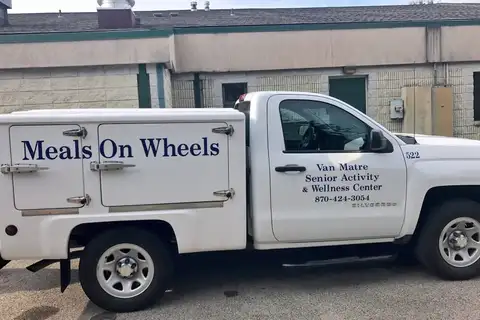
- Home-delivered meals from a nonprofit organization, or a contracted private provider, for people 60+ or people unable to prepare all their meals because of a disability. Programs like the one in the photo above may take SNAP if they are authorized.
- Restaurant meals in states that run the Restaurant Meals Program. Every household member must be elderly, disabled, homeless, or the spouse of an eligible person. The state codes eligible EBT cards, so the restaurant does not ask questions. USDA’s page (updated August 7, 2026) lists Arizona, California, Illinois (Cook and Franklin counties only), Maryland, Massachusetts, Michigan, New York, Rhode Island and Virginia (USDA Restaurant Meals Program). Details in the Restaurant Meals Program guide.
Applying: SSI offices, CAP states and help from others
At a Social Security office. Federal law requires the Social Security Administration to take SNAP applications from people applying for or receiving SSI (USDA, Combined Application Projects, page updated July 20, 2026). If an SSA office does not offer this, apply through your state’s portal, listed in how to apply for SNAP.
Combined Application Projects (CAPs). In 17 states, SSI recipients, usually those who live alone, can get SNAP through a short form with no separate SNAP interview. The SSA interview counts, and benefits are often set from standard amounts. USDA says CAPs extend certification to 36 months and drop reporting requirements. USDA is not accepting new CAPs (USDA). As of October 2024 (State Options Report, page 27):
- Standard CAP (SSA takes the SNAP application during the SSI interview): Florida, Massachusetts, Mississippi, New York, Pennsylvania, South Carolina and Washington.
- Modified CAP (the state uses SSA data to mail SSI recipients a simple SNAP form): Arizona, Kentucky, Louisiana, Maryland, Michigan, New Jersey, North Carolina, South Dakota, Texas and Virginia.
Someone can apply for you. If you cannot get to an office or online, you can name an authorized representative in writing to apply and do the interview for you (USDA). This can be a relative, neighbor or caseworker.
The interview. The state must offer a phone interview if you meet its hardship criteria and ask not to come in. The criteria must include illness, transportation problems, caring for a household member, rural residence and severe weather. Home visits are possible in hardship cases (7 CFR 273.2(e)(2)). Interviews are covered in the SNAP interview guide.
Renewals: 24 months, sometimes 36
Most households are certified for 12 months or less. If every adult in the household is elderly or disabled, the state may certify for up to 24 months, with at least one contact every 12 months (7 CFR 273.10(f)(1)). Two kinds of state project go further.
Elderly Simplified Application Project (ESAP). It is for households with no earned income where all members are older adults, and in some states also adults with disabilities. ESAP offers a simpler application, lighter proof requirements, no renewal interview and 36-month certification. As of October 2024 it ran in 25 jurisdictions: Alabama, Arizona, Arkansas, California, Connecticut, D.C., Florida, Georgia, Illinois, Indiana, Kentucky, Louisiana, Maryland, Massachusetts, Mississippi, New Mexico, New York, Ohio, Pennsylvania, Rhode Island, South Carolina, Texas, Vermont, Virginia and Washington (State Options Report, page 28).
From 2026, ESAP starts at 65, not 60. On June 11, 2026, USDA told states it was changing every ESAP nationwide to exclude people aged 60 through 64 who do not have a disability. The reason given was the new time limit for that age group. States had 60 days to comply unless USDA approved a later date. USDA’s ESAP page, updated October 1, 2026, describes the project as serving people 65 or older. California’s letter to counties explains the change. California renewed its ESAP from October 1, 2026 to September 30, 2031, and moves to the age-65 rule on March 1, 2027. Nothing changed for people with a disability (USDA ESAP page; California All County Letter 26-58, August 21, 2026). If you are 60-64, have no disability and are in an ESAP, expect your state to move you to a regular certification period when it switches. In California that means 12 or 24 months.
No renewal interview in some states. USDA’s waiver list (as of October 1, 2026) shows five states that skip the renewal interview for elderly or disabled households with no earned income. They are Iowa (through January 31, 2027), Kansas (through December 31, 2026), Maine (through May 31, 2027), Missouri (through August 31, 2027) and Nebraska (through June 30, 2027) (USDA Certification Waivers, October 2026).
Renewal deadlines and what happens if you miss one are in SNAP recertification.
Work rules and the time limit after the 2025 law
- 60 and older: exempt from the general SNAP work requirements, including mandatory job training (7 CFR 273.7(b)). Households made up entirely of elderly or disabled members have no work requirements (USDA).
- 60 to 64: since July 4, 2025, subject to the time limit: 3 months of SNAP in 36 unless you work or join a work program 80 hours a month, or meet an exception. States may not force this age group into job training, but you may volunteer (USDA Time Limit Q&A #1, questions 2-4).
- Social Security at 62-64: retirement or survivor benefits alone are not an exception. SSDI or SSI shows you are medically unfit for work, which is an exception (same Q&A, question 5). Caring for an incapacitated person is another.
- 65 and older: not subject to the time limit.
The full rules, waivers and what counts as 80 hours are in SNAP work requirements in 2026.
Where to check your state’s version
States choose their own utility allowances, standard medical deduction amounts, BBCE limits, and whether to run CAP, ESAP or the Restaurant Meals Program. The State Options Report lists show choices as of October 2024. Your state’s manual or agency page may be newer. Find your state’s program name, portal and phone numbers on the state directory.
Sources
- SNAP Special Rules for the Elderly or Disabled, USDA Food and Nutrition Administration, page updated October 1, 2026 (read through the agency’s content host)
- SNAP Fiscal Year 2027 Cost-of-Living Adjustments, USDA memo, August 21, 2026
- 7 CFR 271.2, 273.1, 273.2, 273.7, 273.9, 273.10, 273.12, eCFR, checked October 16, 2026
- Public Law 119-21, sections 10102-10103, July 4, 2025
- SNAP Provisions of the OBBB: Time Limit Changes, Questions and Answers #1, USDA, June 11, 2026
- Restrictions on Internet Expenses and Treatment of Energy Assistance Payments, Q&A #1, USDA, May 8, 2026
- Combined Application Projects, USDA, page updated July 20, 2026
- Elderly Simplified Application Project, USDA, page updated October 1, 2026
- SNAP State Options Report, 17th edition, USDA, published August 2025, data as of October 2024
- SNAP Certification Waivers for State Agencies, USDA, data as of October 1, 2026
- SNAP Restaurant Meals Program, USDA, page updated August 7, 2026
- 7 U.S.C. 2012(k), definition of “food,” U.S. Code
- All County Letter 26-58: ESAP Extension Approval and Modifications to Remove Individuals Aged 60 Through 64, California Department of Social Services, August 21, 2026
- Texas Works Handbook, Texas Health and Human Services: C-120 (Revision 26-4, effective October 1, 2026), A-1420, A-1320, A-210
- 2026 Medicare Parts A & B Premiums and Deductibles, Centers for Medicare & Medicaid Services